In many districts, AI enters classrooms through a top-down process driven by state guidelines and district priorities. In one New Hampshire district, however, AI arrived through the students, completely bypassing administrative involvement. Students had started using AI tools like ChatGPT before school staff, and the district soon faced a chaotic learning environment lacking clear guardrails or shared expectations for appropriate use.
New Hampshire doesn’t yet have a statewide AI education policy, leaving it up to individual districts and teachers to create their own guidelines. As teachers in this district became increasingly concerned about misuse, administration was forced to take a stance on AI. For district leader Jordan Cole, the decision was clear: “We had a choice as a district—do we fight it or do we embrace it? And we formed a committee, and we really looked into it, and we embraced it.”
For the suburban district, deciding on a direction for AI was only the first step. Cole explains that the state’s current approach to guidelines has created tension in classrooms. “We're divided, and I'm sure most schools are,” he says. Some teachers had put up prohibitory classroom signs, featuring “a great big ‘AI’ [with a] red circle around it [and] a slash right through it.” Cole feels that this reaction was justified given the ambiguous policy environment and concerns about academic integrity. “There's a lot of times that's very appropriate, you can't use [AI],” he says. However, he adds that there are also opportunities for students to extract real value from AI, and banning it outright isn’t fair to students or teachers who want to use it to enrich learning.
The district, completely outpaced by its 4,000 students, managed to avoid introducing overly restrictive policies by creating visual frameworks illustrating a human-to-robot spectrum of appropriate AI use. Born out of a collaborative effort between leadership and staff, these visual frameworks aim to clarify expectations and support consistent practices between classrooms. As these shared norms take shape in the district, teachers continue to navigate questions of professional identity, trust, fairness, and accountability around AI in the classroom.
Tiered AI Guidelines Grant Teachers Greater Oversight
With a focus on clear guidance rather than strict mandates, the district leaves it up to teachers to determine exactly how AI is used in their classrooms. Importantly, while teachers are granted broader access to AI, specific guardrails are put in place for students. This tiered approach gives teachers more control over student usage, ensuring students can use AI only when teachers deem appropriate.
Cole explains that many teachers in the district use SchoolAI, an interactive AI platform specifically built for K–12 education. On the platform, teachers can set up custom learning spaces where the AI functions as a learning support rather than an answer engine. Cole says, “We could literally write in the prompt, ‘Do not give the answer, period.’” Instead, the tool is prompted to stimulate critical thinking through question-based dialogue. “Everything's a question,” he continues. “It's to try to lead them on, to help them.” Cole emphasizes how this individualized tutoring “can happen a lot more frequently in the classroom with a bot versus having the teacher do it with 25 kids,” adding that the system allows students efficient access to feedback.
Whether through specialized educational platforms or more general tools, teachers in the district often serve as intermediaries, allowing students to benefit from AI in appropriate contexts. One such teacher, Elliot Morgan, explains how he helped one of his students find a practical workaround to bypass classroom AI restrictions: “They had a big research paper to do, and a student wanted to recraft their research question. And I was like, ‘Oh, you've already done the work. Plug that into AI and have it help you refine it to what you want.’ And I forgot they can't get on to anything like that in here. So, I actually did it on my ChatGPT or my Gemini account.”
Morgan recounts another instance of real-time AI mediation in the classroom where, during a class debate, he used AI to interpret his student’s talking points and create a United Nations-style document to deepen their engagement in the discussion. “As they were talking, I started typing into ChatGPT some of the things they were saying,” he says. “I plugged in what we were doing and then what it created was a memorandum or a position from one of the groups… It re-energized the whole conversation because it added something that I maybe could not have done on the fly by myself.” Morgan’s experience demonstrates that teachers who recognize the pedagogical value of AI may be willing to sidestep district guidelines for specific cases that support student learning.
Yet, while Morgan is willing to embrace AI in his classroom, he acknowledges that other teachers can be more hesitant. He suggests that this reluctance is rooted in fear of the unknown: “What do we fear most? It's the stuff we don't understand and the stuff we can't control.” For many teachers, adopting AI means giving up some control over how their students are learning, a prospect that raises concerns, especially when students may misuse AI to do their work for them.
These issues reflect broader patterns in how teachers approach AI. The classroom environment has changed faster than the policies or practices to manage it, and teachers are starting to rethink how they assign and evaluate work. In a survey by the EdSignals Studio, nearly one-third of teachers said they can’t reliably detect AI use in student work, and 27% report difficulty determining whether students are actually understanding the material when AI is used for learning. Teachers need clear ways to know when, how, and to what extent students are using AI to complete school assignments. Stronger systems of classroom oversight can make teachers more confident in their ability to catch misuse of AI and check for real understanding, reducing hesitation rooted in ambiguity.
Establishing clear expectations around how AI use is monitored can give teachers greater confidence in their professional judgments, empowering them to experiment with AI and permit students to use it under supervision. Preserving teachers’ sense of agency in the classrooms is a core prerequisite to AI adoption. “That control is key,” Morgan says, explaining that district guidelines allow him to use tools like SchoolAI while still monitoring what his students are doing.
Shared Expectations Ease Tensions Around Unfair Use
The district’s structural guardrails define who can use AI and how, but some teachers still face interpersonal and ethical tensions as they navigate what responsible AI use looks like in practice. Some of this tension stems from the perceived double standard that teachers are permitted to use AI freely while students face more rigid restrictions. According to Morgan, some students feel that this imbalance is unfair: “The students will often say to me, ‘Oh, was this AI?’ And I'll say ‘yes…’ but there's that sense of, ‘Oh, you get to use AI, but we don't.’” He adds that students “will maybe say that [the] teacher is a hypocrite because they can't use it, but then the teacher [uses] it to do their work for them.” Morgan is uncomfortable with this tension, and actively tries to avoid the “Is this AI?” conversation with his students. As students start catching on to the formulaic appearance of AI-generated documents, he finds himself “changing the font or changing the bullet points” so as not to invite questions about the source of the materials.
Morgan’s concerns are grounded in real classroom experiences, where students have called him out for mistakes in AI-created content: “I ran out of time on planning one time, and I was like, ‘Oh, I need this quick assignment.’ Boom, boom, boom. I cranked out an assignment. It was a matching game, and I gave it out to the students, and they said, ‘Everything's just in order. One lines up with A, number two lines up with B.’” Reflecting on the interaction, Morgan concedes, “that's what you get when you just rely on [AI].”
Beyond issues of fairness, teachers also question whether overreliance on AI will challenge their professional identity and instructional expertise. For example, Morgan is enthusiastic about the ways AI has augmented his instructional workflow, saying “I love it, I use it, I think it's making me a better teacher.” However, he’s also concerned about developing a dependency on the technology: “Am I being too reliant on it? I question, is it going to erode my skills as a teacher? Am I losing my ability to fully plan?” AI-driven cognitive atrophy is a real concern among experts, especially when AI is used to replace rather than supplement critical thinking.2 Morgan describes actively monitoring his reliance on AI, often wondering whether he’s “cheating” by using generative tools to summarize materials.
While the state of New Hampshire doesn’t currently offer guidance to help teachers navigate these ethical concerns, Morgan’s district imposes strict policies around the use of AI for grading student assignments. Teachers are free to use AI for marking assignments with objectively right or wrong answers, such as multiple-choice quizzes or math questions. However, Cole explains that teachers must personally evaluate subjective student work: “If a child writes something that needs to go through the mind of the adult, we do not allow a graded document to go through AI.” Guidelines like these help preserve the essential human skills of interpretation and judgment in the classroom. At the same time, they ensure expectations go both ways, so that students and teachers are equally accountable for cognitive work that requires critical thought.
Shifting the Focus from Blanket Bans to Future Preparedness
Leadership in the district directly addresses tension among teachers and students by reframing AI as a legitimate tool and establishing clear guidelines for use in classrooms. Instead of banning students from accessing AI, the district has established a set of shared standards to resolve ambiguity. In Cole’s district, these shared norms take the form of an infographic. The visual framework specifies what appropriate AI use looks like on a human-to-robot spectrum, ranging from tasks that should be entirely human to those that are allowed to benefit from AI support. “It starts out with a full human being, and then it morphs into a full robot, and it tells the amount of help a student can use with AI,” Cole says. He adds that teachers who have anti-AI signs in their classrooms will have to take them down now that the district has established shared standards for use, though teachers are still free to prioritize human-only assignments within that framework.
In guiding students through appropriate use of AI, the district is shifting the focus from restricting AI to preparing students for college and job expectations. Essentially, district leaders are positioning the classroom as a controlled training space where students can learn boundaries and best practices for using AI. “I kind of think [banning AI] is not fair to the kid,” Cole says. “They're using it now. They leave the building, we have no control [over] what they do when they get home. Instead of banning it, we're really trying to teach the ethical use of it and make sure kids are using it appropriately.”
Part of this involves preparing young learners for college classes where students will have the freedom to use whatever tools exist. Asynchronous online classes, for example, are nearly impossible for instructors to control. Morgan feels that it’s important to prepare his students now so they can extract educational value from AI tools in these unrestricted learning environments: “That's my worry [with] online programs and even in high schools… that it's going to just become not learning, [but] just doing, just getting it done.” Morgan draws a parallel between AI-mediated work in professional settings and emerging AI practices in education. “In the business world,” he says, “you'd have a CEO who requests a year-end report... nobody ever actually wrote or read the 50 pages. I feel like the same could be in education as well.”
Administration stresses that preparing students rather than prohibiting use of AI is crucial for setting them up for success after graduation. To achieve this, Cole explains that the district aims to give students guided practice with practical AI tools that support the learning process: “We're trying to make sure they understand the difference between a copy and paste and actually doing some thinking and brainstorming… using the tool to check their work and to give them ideas and feedback is far different than having AI do the work for you.”
Teachers, too, can benefit from shared frameworks dictating appropriate AI use, particularly when it comes to lesson planning, grading, and evaluating academic performance. What’s missing now are clear guidelines to help educators assess whether students are actively learning when they use AI.
One framework that might work here is an inverted version of Bloom's Taxonomy.3 Traditionally, the educational framework categorizes learning objectives into a hierarchy that starts with recollection—such as remembering facts and understanding concepts—and ends with creation, where students produce original work. But when students use AI, the pyramid flips (Figure 1). Generating creative tasks becomes easy and fast, and evaluating output alone is no longer adequate for assessing critical thinking and conceptual understanding. Classroom instruction and student evaluations must then focus on the foundational layers: remembering, understanding, applying information to new situations, and drawing connections between ideas. These foundational cognitive skills are the ones that establish genuine learning when creation is the starting point rather than the final outcome.
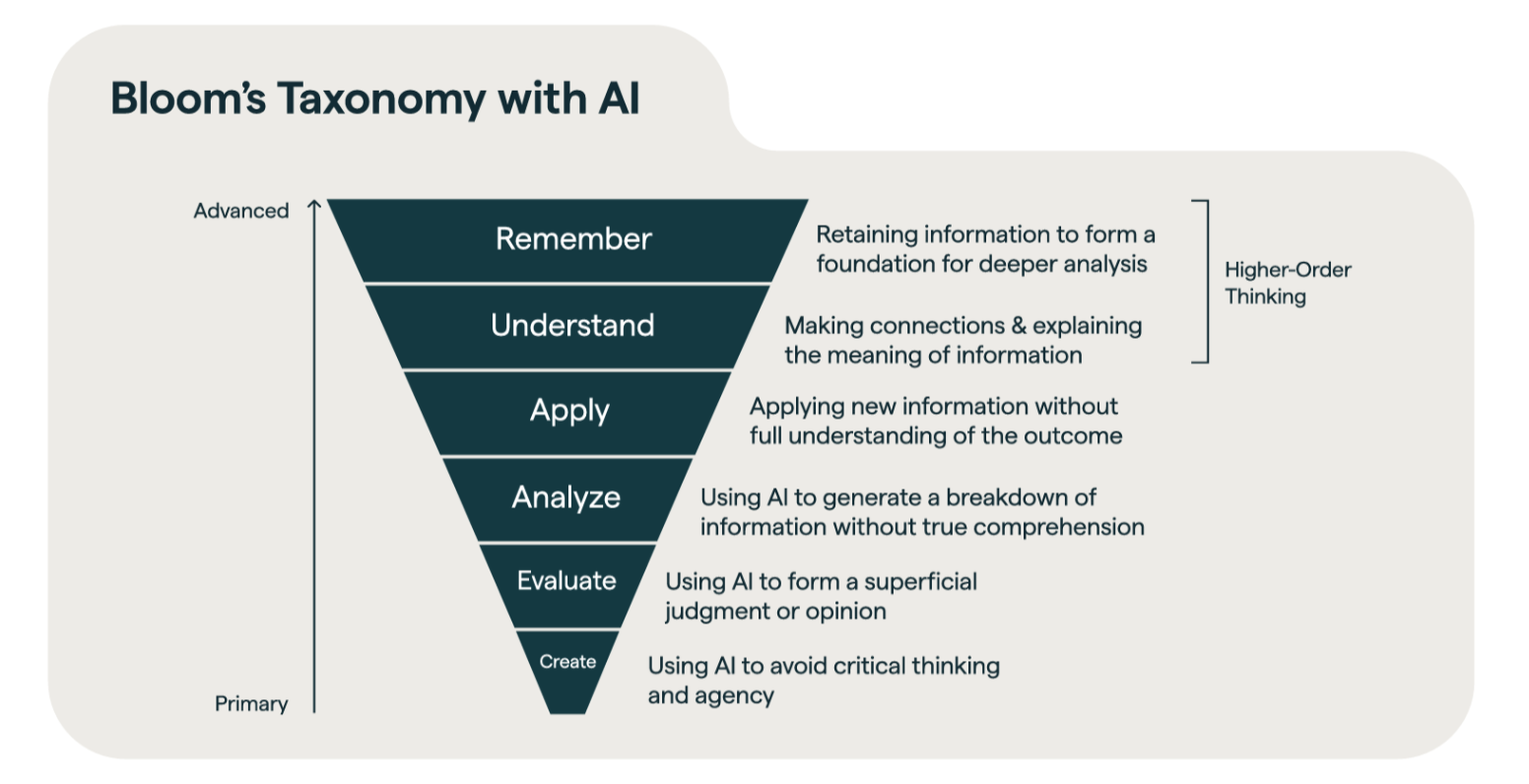
Figure 1. Inverted Bloom’s Taxonomy.
Source: Grammarly, 2025–26 AI Trends Report (San Francisco: Grammarly, 2025), 5.
Filling State Policy Gaps with District-Level Guidance
Faced with an unregulated state policy environment, this New Hampshire district navigates AI use in schools by prioritizing shared expectations over strict regulation. The district’s human-to-robot infographic helps resolve ethical tensions around trust, fairness, and academic integrity, bringing clarity to an ambiguous AI environment and giving teachers a greater sense of control over their classrooms.
At the same time, by focusing on ethical use rather than prohibition, the district prepares students for educational and professional environments where clear boundaries may not exist. As Cole says, “It's important in life… that they know how to use [AI], and hopefully in a way that they're still using their minds.” Ultimately, the district’s strategy reframes the issue of AI in the classroom away from the binary question of banning or allowing its use, toward a spectrum of ethical practice where students and teachers are empowered to exercise their own judgment.
Names in this article have been changed to preserve anonymity.
Sources
Mineo, L. (2025, November 13). Is AI dulling our minds? The Harvard Gazette. https://news.harvard.edu/gazette/story/2025/11/is-ai-dulling-our-minds/
EdSignals Studio, Ecosystem Study #2, 2026.
Sturgill, A. (2026, April 21). Assessment in the Upside Down: Academic AI with Students as the Audience. Center for Engaged Learning. https://www.centerforengagedlearning.org/assessment-in-the-upside-down-academic-ai-with-students-as-the-audience/