Skip to main content
EdTech holds real promise for addressing learning gaps when tools are well-designed, well-implemented, and aligned with student needs. However, districts often face significant uncertainty when evaluating products and deciding what to adopt. Educational leaders must filter significant noise to identify the most effective tools, assess whether products can demonstrate impact, and determine whether they will work with their district’s systems and capacity.
These questions take center stage during the evaluate stage of EdTech purchasing. This is when districts assess how well a new product might solve a specific problem, align with existing curriculum, and support broader educational goals. Decision-makers have to balance these priorities with technical, integration, and privacy needs to ensure products also align with various standards. Without question, evidence of impact, fit, and relevance is critical for helping districts narrow down their options.
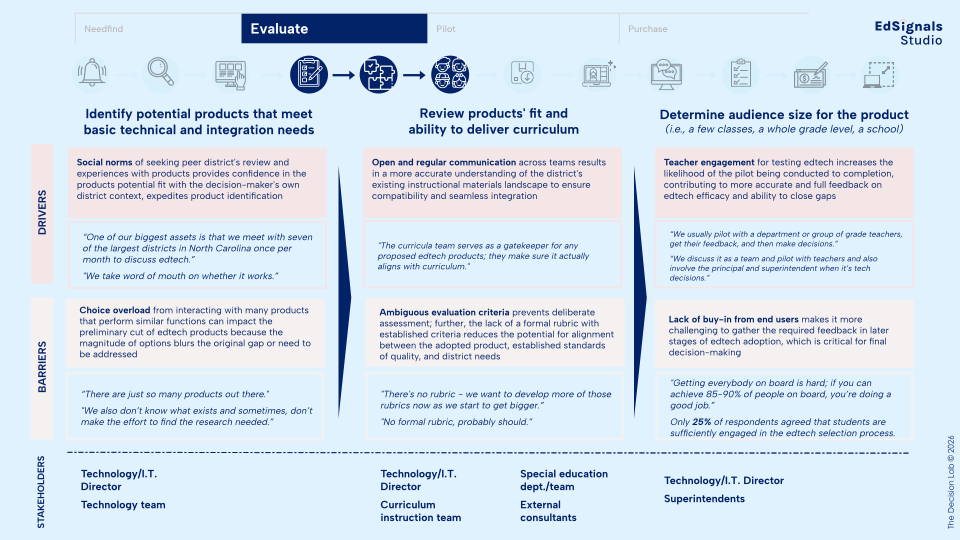
However, districts often lack access to clear or trustworthy evidence of how well a product might work in their local context. Not only is high-quality evidence hard to find, but districts run into several common barriers during the evaluation process that limit evidence use. From choice overload that hinders deliberative product research to ambiguous evaluation criteria and a lack of stakeholder buy-in, many districts are left navigating these important decisions with limited clarity. Drawing on EdSignals Studio research with both district leaders and EdTech vendors, this article takes a closer look at these barriers and highlights opportunities to strengthen evidence use during evaluation, so classrooms can fully harness the promise of high-quality EdTech.
Choice Overload Slows Deliberative Evaluation
When district leaders sit down to evaluate potential EdTech solutions, they’re faced with a large number of tools to consider. What makes this process particularly challenging is that many tools appear similar on the surface but lack clear insights into their actual efficacy.1 Products come with different demos, reviews, case studies, and claims, creating an abundance of information that can quickly contribute to choice overload. Rather than supporting district decisions, this makes it more difficult to evaluate and compare tools thoroughly.2 Often, it means decision-makers spend significant time gathering information, only to feel less confident in their final conclusions.
As a result, instructional gaps established during the needfind stage can blur, creating confusion around what evidence districts should prioritize and how to apply it locally. While district demand for evidence is high, relying on external evidence alone can create new obstacles. For example, data from academic literature is difficult to apply to the context of a specific district, diluting the value of this data for decision-makers who are already grappling with an overabundance of information.
Organizations that support districts can play a vital role in encouraging evidence use at this stage, as educators often express a greater trust in third-party reviews than research run by product vendors themselves.3 Small teams, in particular, find that such reviews are easier to access relative to other sources of information, including academic papers.2 By using tools like the EdSignal Studio’s Evidence Uptake Framework, third-party evaluators can help make this data more actionable by translating research findings into formats that are easier to access and digest.
Making it easier for districts to find high-quality products also requires strengthening the social signals that guide decision-making. For instance, research with district leaders suggests that peer validation can expedite the evaluation process by helping leaders narrow their options and build confidence in their choices.2 Peer districts’ experiences with products can provide invaluable insight into how well those products might fit within a similar district’s context. This can help districts focus their attention on a smaller set of products, retaining time and cognitive capacity to evaluate these options carefully.
Finally, vendors can play a supportive role by showing up at conferences with hyper-local data about their products. This helps district leaders see success in their local context and demonstrates market awareness beyond generic pitches. District leaders seeking this contextualized information can prioritize pitches from vendors that co-present with a trusted district partner, as these sessions tend to draw on more local implementation insights.5

Ambiguous Evaluation Criteria Undermine Evidence Use
During EdTech evaluation, districts often lack a clear, shared definition of what counts as a “good” product. While many are looking for indicators such as quality, impact, fit, and equity, these criteria are rarely defined in a way that’s easy to measure or apply consistently. Just as with core curriculum adoption, ambiguous evaluation criteria present a significant barrier for EdTech procurement. Without a consistent structure for evaluating products, bias can sway evaluation decisions. For example, confirmation bias can lead decision-makers to seek out information in support of a preexisting belief—such as the assumption that a familiar tool is the best option—while overlooking contradictory evidence.4
A standardized system can help mitigate bias in the evaluation process, but creating formal rubrics for EdTech remains a consistent struggle. Technology changes rapidly, and it’s hard to find a rubric that adapts to the ever-evolving tech landscape, let alone one that works across districts with varying needs.2 At the same time, pre-determined criteria can sometimes be too rigid, unintentionally narrowing product selection to those that fit established categories and preventing decision-makers from considering innovative options that break the mold. Yet, without some shared structure, districts struggle to find products that back up their claims with evidence of real impact.1
Evidence-based evaluation frameworks offer a more flexible alternative to rigid rubrics. The International Society for Technology in Education (ISTE)’s Teacher Ready Evaluation Tool, for example, provides decision-makers with a standardized way to assess a tool’s fit in different contexts and classrooms.4 Likewise, researchers have proposed frameworks to help evaluators probe EdTech vendors, uncovering key insights about how these developers use evidence in product design and improvement. For example, part of the intention behind the EdTech Evidence Evaluation Routine (EVER) is to help procurement teams reflect on the methodological quality of evidence provided by product developers.1
These frameworks act as guides rather than fixed checklists and can more easily be adapted across districts to reflect their unique goals. They also provide a starting point for cross-team discussions, ensuring everyone is on the same page about needs and priorities before products are selected for evaluation.
Limited Teacher Buy-In Weakens Evaluation Outcomes
By the time districts reach the evaluate stage, they have typically already established the problems that need solving and sought out available tools that might be a good fit. Teachers may be asked to review or pilot these options, but their voices aren’t always involved in shaping the criteria that guide the initial product selection. When evaluation frameworks don’t speak to classroom implications—such as teacher usability, student engagement, or daily time constraints—teachers can struggle to see how their input matters at all. Students, another key group of EdTech users, are also often left out of these discussions; only 25% of district leaders involved in EdTech purchasing agree that students are sufficiently engaged in the product selection process.2
When these end users aren’t on board from the beginning, districts face difficulty garnering feedback on proposed products and determining how well they actually address learning gaps. Securing early buy-in is also essential for conducting meaningful product pilots and ensuring smooth integration upon adoption.2 When the people who make purchase decisions are not the same people who will be implementing the tools in classrooms, implementation gaps are expected.5 Teachers might not understand why a product matters or how it fits with their instructional priorities.
Strengthening engagement at this stage means involving teachers in earlier discussions of need, but also prioritizing evaluations around classroom-specific pain points rather than system-level gaps. Teachers, for instance, consistently value tools that provide differentiated lessons to support students at different levels and abilities over those that address singular learning goals.3 Vendors can support this process by providing district leaders with teacher-facing materials, such as concrete implementation guides and classroom data, so those involved in purchasing can make a strong case to their end users.5
Another effective way to increase buy-in from end users is to assemble a team of “tech-savvy” teacher advocates to participate in product evaluation, model the use of new tools, and share their experiences with peers. This form of social proof can help build trust among stakeholders and encourage broader engagement during the evaluation process. Later, these same teacher ambassadors can also support a smooth integration by championing new tools and serving as a trusted source of support to new users.
Helping Districts Align Needs with High-Quality Market Solutions
From choice overload and ambiguous evaluation criteria to limited teacher buy-in, districts face several challenges when evaluating EdTech products. These barriers stem from a common issue: districts lack clear strategies for accessing and interpreting evidence on product quality and classroom fit. The result is delayed decisions, inconsistent evaluations, and limited meaningful impact on student learning.
Encouraging evidence use during EdTech evaluations requires coordinated action from both districts and partners across the ecosystem. Districts can engage end-users, seek social proof from peers, and establish evaluation criteria that reflect what matters most to teachers and students. At the same time, partners such as third-party reviewers are well-positioned to translate evidence of quality into usable signals and adaptable frameworks that help districts compare options and make confident decisions about what to pilot and ultimately adopt in classrooms. Together, actors on both sides of the purchasing ecosystem can reduce barriers in the evaluation process and support stronger evidence-based decisions that better serve students and educators.
Sources
- Kucirkova, N., Brod, G., & Gaab, N. (2023). Applying the science of learning to EdTech evidence evaluations using the EdTech Evidence Evaluation Routine (EVER). NPJ science of learning, 8(1), 35. https://doi.org/10.1038/s41539-023-00186-7
- EdSignals Studio, Smarter Demand: Dimensions of Quality in Purchasing Decisions, 2022
- Pusey, S. (July 12, 2019). For Better EdTech Purchasing, Ask These 4 Crucial Questions. EdScoop. https://edscoop.com/edtech-purchasing-procurement-k12-tips/
- McLemore, C. & Rae, J. (June 24, 2024). How District Leaders Make Edtech Purchasing Decisions. EdSurge. https://www.edsurge.com/news/2024-06-24-how-district-leaders-make-edtech-purchasing-decisions
- EdSignals Studio. (2025). 2025 Annual Report.https://edsignals.org/edsignals-studio-annual-report-2025/