Skip to main content
Numerous organizations, particularly those of smaller or recent establishment, face the challenge of broadening their user base, especially when district buyers lack awareness of their organizational presence. An organization in this predicament was looking to understand and address two things with all district buyers but especially about district buyers in specific states of interest:
- What are the biggest barriers preventing school districts from finding their resources?
- What are the barriers preventing school districts from trusting the organization’s resources enough to interact with them?
To help this organization expand their reach, we leveraged key tools to better understand the information-seeking behaviors of their target audiences.
Summary

Lack of awareness about the organization
District buyers remain unaware of the organization and do not know about their resources; however the organization is very small and has limited human resources to dedicate to marketing efforts.

Leverage buyers’ info- seeking behaviors
Understanding where and how district buyers come to learn about organizations that disseminate these kinds of resources/services and meeting them where they are.

Optimized marketing strategies
Based on the research findings, we shifted the organization’s efforts towards the most fruitful marketing channels then leveraged partnerships to address capacity gaps.
Approach
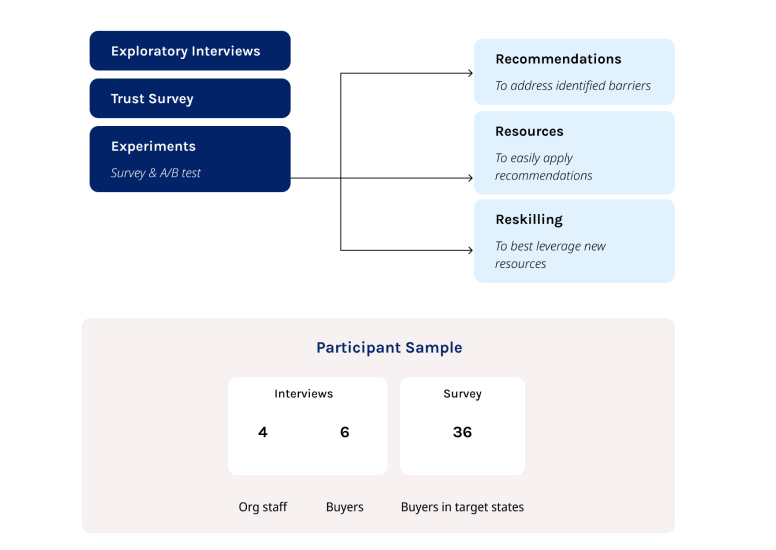
Our approach commenced with diagnostic interviews targeting buyers in the organization’s states of interest. These interviews delved into their information-seeking behaviors, adoption processes, and specific needs related to the organization’s resources, aiming to discern whether the organization could address these needs. Data from these interviews informed the design of a survey, enhancing generalizability and uncovering preferences without relying solely on self-reported data.
Within these surveys, A/B tests were conducted to ascertain optimal channels and assets for the organization’s marketing efforts. Subsequently, insights from the survey guided the organization in reevaluating its strategy to align more effectively with user preferences in the identified states of interest.
TOOLS USED
Some of the tools we applied to support this organization was to better define their capacity gap, while others were used to address the identified gaps. Below we highlight how the four tools we used were incorporated in this process.
Impact
Our diagnostic interview and usability tests helped us understand key pain points in the resources that the organization was hoping to center the marketing around and to develop a more customized survey to understand school district buyers in the states of their interest.
Our survey revealed a lack of awareness about the organization’s existence among the target audience. Additionally, it indicated that the organization’s focus on social media for marketing did not align with the preferred information sources of their audience, who relied more on conferences and warm emails. Lastly, the survey determined which conferences the organization’s target audiences were attending in order to leverage that in our recommendations.
In our A/B tests, we discovered a lack of clarity regarding the target audience and purpose of the organization’s resources. Additionally, the appearance of extra resources increased the likelihood of buyers wanting to explore further.
The outcome was an optimized marketing strategy that leveraged partners to address organizational capacity gaps.
Recommendations
Mapping the organization’s processes allowed them to shift their marketing focus away from previous main outreach channel (social media) to the channels actually used most by district buyers in the states of interest (conferences and warm emails).
Based on the A/B tests, we recommended clearly stating the purpose and target audience of their online materials and adding resources to increase the likelihood that buyers continue exploring the organizations resources once being exposed to it.
Resources
We developed a comprehensive metrics repository to support the organization in evaluating the success of their new marketing focuses.
We also built a bank of 43 potential partners in the primary state of interest, with 24 completely new entities they had not previously considered, including details on how each aligns with the organization’s strategy.
Reskilling
We helped the organization understand alignment and opportunities for partnership by creating a partnership strategy and partner profile template, and completing the templates for 5 partners. This work supported the establishment of a new partner.
References
Cunningham, Linda C., and Lisa A. Tedesco. “Mission Possible: Developing Effective Educational Partnerships.” Journal of Higher Education Outreach and Engagement, 79–89. 2001.