Skip to main content
EdTech adoption ranges from solo efforts to committee-led reviews. We explore the procurement cycle and the unique barriers faced by three buyer segments to show how Managers, Advocates, and Enthusiasts decide which tools belong in the classroom.
Three Core Curriculum Segments Demonstrated Predictability

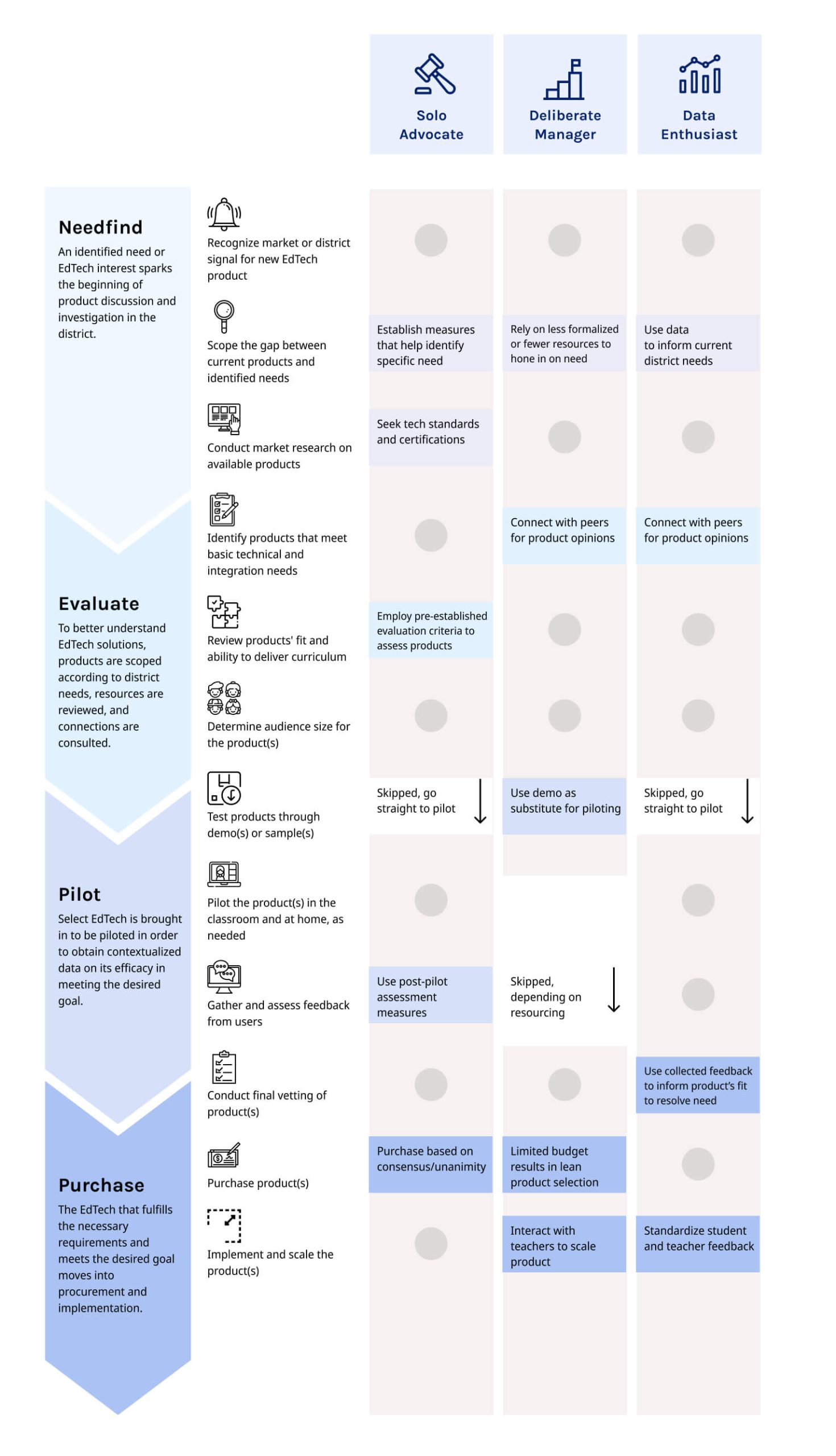
Deliberate Managers employ standardized steps for procurement using pre-established criteria to assess products. They are highly intentional in their process, and may involve various stakeholders.
Given the rigidity of the process, they may be less responsive to contextual changes or less likely to consider novel products that don’t fit pre-established criteria.


Solo Advocates spearhead EdTech purchasing while relying on limited resources and expertise to ensure alignment with the district’s vision.
However, Solo Advocates may face limited resources, resulting in insufficient evidence engagement as well as skipped or reduced steps.


Data Enthusiasts are determined to leverage external and internal data to inform decision-making while optimizing for culturally relevant solutions.
However, Enthusiasts may run into obstacles when they cannot obtain the desired external evidence, or may have trouble with successfully translating available evidence into their local context.

The EdTech Segments can be Identified Based on Relative Differences in District Size, Priority Classification, and ISTE Use

Segments revealed unique preferences for evidence sources
Preferred Sources of Evidence
- Information about standards and certifications via websites
Why is the Source Preferred?
- Standards provide a systematic and replicable approach to product validation
Greatest Barriers to Evidence Use
- Sunk costs, related to piloting
Preferred Sources of Evidence
- Peer reviews
- Conferences and forums
Why is the Source Preferred?
- Peer reviews are easy to access relative to other sources of information
Greatest Barriers to Evidence Use
- Minimal end user feedback
Preferred Sources of Evidence
- Internal formative and summative assessments
- External sources such as academic literature and vendor reports
Why is the Source Preferred?
- Data provides an objective metric on which to base subsequent decisions
Greatest Barriers to Evidence Use
- Accessibility and availability of evidence
The Procurement Journey for Core Curriculum Purchasing
Highlights the similarities across the three segments and involves four stages: Needfind, Evaluate, Pilot and Purchase.
Click to review