Skip to main content
Curriculum purchasing decisions begin long before committee meetings and vendor pitches. Early on, district leaders notice signs that current learning materials are no longer meeting student needs; test scores are dropping, state standards are shifting, and teachers and parents are calling for change. However, districts often struggle to act on these early signals, deferring action to regular renewal cycles or future points of crisis. If the evidence is there, why is it so hard to act on it?
This article focuses on the “Signal” stage of the curriculum purchasing journey, the point where districts first begin evaluating evidence that something isn’t working. During this stage, district leaders assess early signals of misalignment between current materials and student outcomes to determine whether changes are needed. However, these early signals are often weak or challenging to interpret, making it difficult for district leaders to pinpoint where a gap exists and what issues need to be addressed.
In the following sections, we explore what makes the earliest stage of curriculum purchasing so fragile, especially in districts operating with limited time and human resources. Through surveys and interviews with district-level core curriculum purchasers across 50 U.S. states, the EdSignals Studio uncovered a handful of key drivers that help districts recognize the need for new materials sooner and identify barriers that blur those early signals.1 Together, these insights reveal practical solutions to help districts strengthen their ability to act when they encounter early signs of need.
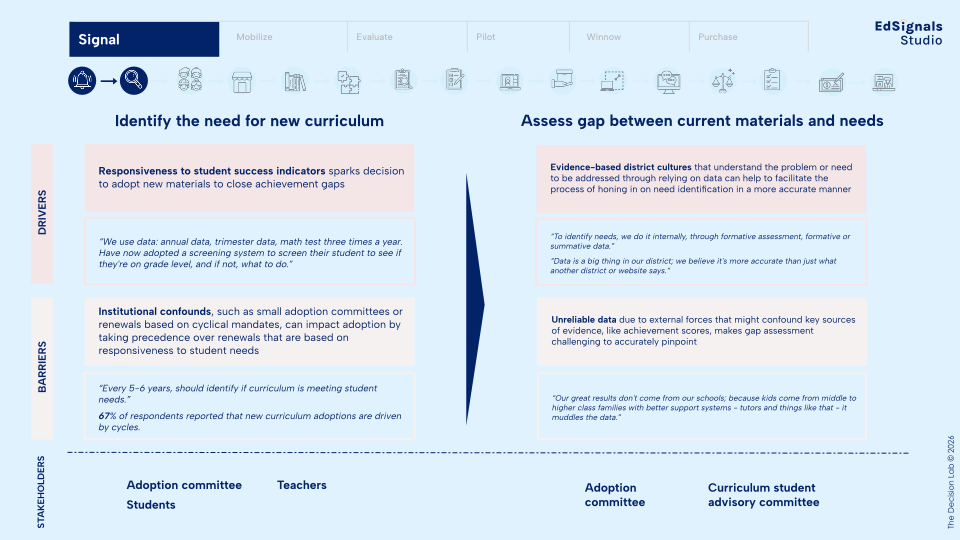
Responsiveness to Student Success Indicators Sparks Adoption to Close Learning Gaps
Often, the first signal that it might be time for new materials comes from student performance, such as test scores, graduation rates, and achievement gaps. Many district leaders report using annual data, trimester data, and regular testing alongside screening systems to ensure students are performing at grade level and identify what to do in the case of learning gaps.1
When districts are responsive to these student success indicators, they can act quickly to close academic disparities. For instance, research from the Learning Policy Institute found that several “positive outlier” districts in California—in which students consistently outperformed their peers from other districts—were leveraging data to identify and address student needs.2 In fact, all of the positive outlier districts used data to flag individual students who could use additional supports or targeted interventions, ensuring more equitable opportunities and outcomes.
Early student success signals lay a strong foundation for strategic and timely decision-making, but only when districts have the resources to interpret the available data. In districts where staff or time are more limited and decision-makers are stretched thin, the ability to spot emerging trends and react quickly to performance declines can become deprioritized in favor of other urgent responsibilities. This is where adoption committees and professional development providers can support districts in identifying and acting on early signals.
Promoting the uptake of systems-level data dashboards, for example, can enable the early detection of performance dips, allowing districts to respond promptly to student success indicators with internal reviews.3 These dashboards make abstract performance data more salient, intuitive, and actionable, so decision-makers can more easily identify areas for improvement. Similarly, designating analytics staff to monitor performance data—even part-time—can ensure trends surface earlier. It’s also worth noting that smaller districts with limited resources often rely on County Offices of Education (COEs) and Education Service Centers (ESCs) to help analyze student performance data and guide material selection.4 Encouraging this form of regional collaboration can allow districts to pool analytics expertise, uncover system-wide patterns, and act on signals of need earlier.
Institutional Renewal Cycles Take Precedence Over Need-Based Renewals
Even when districts are responsive to student needs, cyclical renewal mandates can encourage districts to defer action to scheduled renewals. As many as 67% of districts report cyclical renewals, with many following cycles of five to six years.1 While these renewal cycles can encourage districts to prioritize periodic curriculum reviews, these often become the only signal that change is needed in resource-constrained systems. In fact, many districts report that the release of new state standards or publisher timelines serves as a common trigger for reviewing curriculum materials, rather than internal student data.5
How do these institutional cycles shape decision-making? Even when districts strive to be responsive to student needs, cognitive biases rooted in routine can stall action. For example, decision-making inertia is often exacerbated by the status quo bias. This behavioral barrier encourages decision-makers to maintain the current state of affairs because it’s familiar and low-risk, even if potential changes would lead to better outcomes.5 Without access to clear or relevant data to support an informed decision, the status quo feels like the safest path, at least until a renewal cycle necessitates change.
Availability bias—a tendency to rely on salient or memorable information over more comprehensive evidence—can also discourage districts from acting on student learning data between cycles. As a result, districts might overweight visible signals of compliance over more rigorous evidence that provides a more comprehensive picture of student need. Memorable cues for change, such as renewal dates, state standards releases, or vendor reminders, become the default triggers for action.
To address biases like these, the Studio developed and piloted a debiasing process that helps district leaders recognize and mitigate cognitive biases that interfere with evidence use.6 In the pilot, district leaders received individualized reports identifying their top decision barriers, as well as tailored strategies to overcome them. For example, prompting decision-makers to perform a risk-benefit analysis can help them move beyond choices that feel intuitively “safe” and consider options that may lead to better outcomes. Simply raising awareness of biases shifted how distinct leaders thought about curriculum decisions, encouraging them to reflect on current routines and create more thorough, intentional processes to avoid bias.
Evidence-Based Cultures Aren’t Enough Without Deep Data Fluency
In districts with an evidence-based culture, staff are trained to interpret external research and use independent curriculum review tools proactively. These data-literate districts can respond more quickly to student success indicators and identify areas for improvement. Fortunately, many districts report a strong reliance on evidence; over 80% of district leaders agree that evidence informs their adoption decisions.7
However, many districts—even those with an evidence-based culture—may struggle with low data fluency, limited time, tools, and staff to comprehensively interpret student outcome data.8 In these systems, identifying signals of student need depends more on intuition or social proof, where decision-makers rely on what their peers are doing rather than what the evidence shows.1 The result is that purchasing decisions are informed by external trends rather than internal data depicting real student needs. For example, if nearby districts aren’t making curriculum changes, this can be taken as social proof that change is unnecessary.
These insights tell us that a district’s ability to respond to early signals depends not only on the quality of data available but on its capacity to evaluate and understand this data. Districts struggling with this may consider encouraging certifications in data evaluation for key staff to make full use of available student performance information. Professional development providers should also consider this angle when working with districts that have a strong evidence-based culture but still struggle to adopt curricula that adequately meet classroom needs.
Data Distortion Blurs Signals of Student Need
Even in districts with evidence-based cultures, unreliable or fragmented data can obscure signals of need. Confounding variables that affect student performance—such as student demographics and instructional changes—can make it difficult to determine exactly what’s affecting student performance and whether new curriculum materials would be beneficial. As one curriculum purchaser noted, “Our great results don’t come from our schools, because kids come from middle to higher class families with better support systems—tutors and things like that—it muddles the data.”
When student backgrounds skew scores, strong test scores can mask weak materials, and vice versa. Analyzing confounded data can be overwhelming to district leaders, especially in systems without the necessary data literacy to sift through the noise. This can result in a decision barrier known as ambiguity aversion, where decision-makers delay acting in the face of uncertain or ambiguous information to avoid potentially making the wrong choice.4
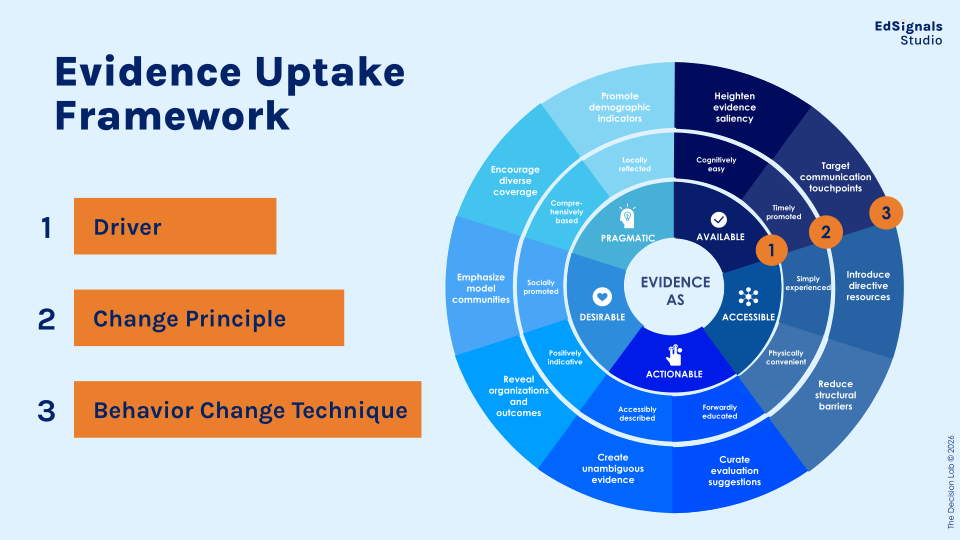
Removing ambiguity from early signals is crucial for preventing decision-makers from delaying action out of confusion, overwhelm, or fear of making a regrettable mistake. To make data more actionable, districts and partners can follow the Evidence Uptake Framework, a foundational method for encouraging evidence use by district leaders. When signals of need are blurred by confounding factors, the framework encourages partners—such as third parties that evaluate curricula—to simplify and contextualize data so that leaders understand why it matters and what kind of response it suggests.
Shifting from Weak Signals to Informed Decisions
While district leaders often spot warning signs that current curriculum materials are no longer meeting student needs, signals that are too weak, ambiguous, or difficult to interpret can delay action, especially in resource-constrained systems that struggle with data fluency. Common cognitive biases such as ambiguity aversion and the status quo bias can further weaken these signals, encouraging decision-makers to stick with the predictability of rigid renewal cycles and familiar curriculum purchasing processes.
Strengthening curriculum purchasing decisions starts with enhancing the early signals that spark proactive decision-making. Through capacity-building work, debiasing strategies, and tools like the Evidence Uptake Framework, the Studio helps district leaders and district partners promote evidence-use through every phase of the purchasing journey, starting from the very moment early signs of student need first appear.4
When applied early, these interventions help build a culture of data use long before adoption begins. From promoting systems-level data dashboards to debiasing decision-making and appointing dedicated analytics staff, districts can apply these insights to guide timely, evidence-based action.
Sources
- EdSignals Studio, Smarter Demand: Dimensions of Quality in Purchasing Decision, 2022
- Burns, D., Darling-Hammond, L., & Scott, C. (2019). Closing the opportunity gap: How positive outlier districts in California are pursuing equitable access to deeper learning (research brief). Palo Alto, CA: Learning Policy Institute.
- Curran, F. C., Carlo, S., & Harris-Walls, K. (2024) Making the Data Visible: A Systematic Review of Systems-Level Data Dashboards for Leadership and Policy in Education. Review of Educational Research. https://doi.org/10.3102/00346543241288249
- EdSignals Studio, Cohort 1, 2025
- EdSignals Studio, Market Analysis: K-12 Teacher Prep Decision Maps, 2020
- EdSignals Studio, Smart Demand: Integrating Buyer Insights into Signals for Solutions, 2024
- EdSignals Studio, Cohort 2, 2025
- Ronka, D., Geier, R., & Marciniak, M. (2010). A practical framework for building a data-driven district or school: How a focus on data quality, capacity and culture supports data-driven action to improve student outcomes. PCG Education. https://publicconsultinggroup.com/wp-content/uploads/2024/09/edu_data-driven-district_practical-ideas_white_paper-1.pdf