Skip to main content
The early weeks of curriculum adoption shape the choices and challenges that follow, well before materials are reviewed and programs are piloted. Small frictions at this point can snowball into significant downstream effects, making the mobilize stage of the curriculum adoption journey especially critical. This is when districts focus on forming adoption committees, recruiting teachers and administrators to identify needs, and shortlisting curriculum options for later review.
The mobilize phase is deceptively difficult, as districts often struggle to assemble diverse adoption committees equipped to evaluate materials effectively. Early in the adoption process, engaging busy teachers is a persistent challenge, meaning that valuable voices are often excluded from the conversation. At the same time, a lack of alignment among key stakeholders can undermine efforts to meet everyone’s needs. Compounding these organizational challenges, adoption committees also have to grapple with overwhelming program offerings and increasingly complex state standards.
Grounded in interviews, surveys, and pilots with district administrators and teachers, the EdSignals Studio has identified several interventions that can help strengthen early curriculum purchasing decisions. In this article, we explore ways to involve key voices in the curriculum conversation, manage complex stakeholder interests, and cut through information overload during this pivotal part of the purchasing journey.
Engaging Busy Teachers for Essential Early-Stage Input
When assembling stakeholders to evaluate potential curriculum options, important voices are often missing. Despite having the best understanding of classroom needs, a majority of teachers do not feel adequately involved in the curriculum adoption process—only 24% feel satisfied with their level of engagement.1 Many teachers are also unsatisfied with the amount of information they receive about the curriculum adoption process, and just 36% agree that districts engage them in a way that fairly draws on their expertise.
While administrators report slightly higher engagement than teachers, most still feel unfamiliar with the reasons behind curriculum selections.1 Without fully understanding the “why,” it can be difficult for administrators to mobilize and motivate teacher participation. There are also structural barriers that discourage busy teachers from participating. In county-guided adoptions, for example, teachers must invest significant time and energy to participate, since training and committee meetings often take place at county offices outside the district.3 This invested effort can create a sunk cost effect, where adoption committees start to feel a commitment to early decisions because of the resources already spent, potentially overlooking better options that come up later.
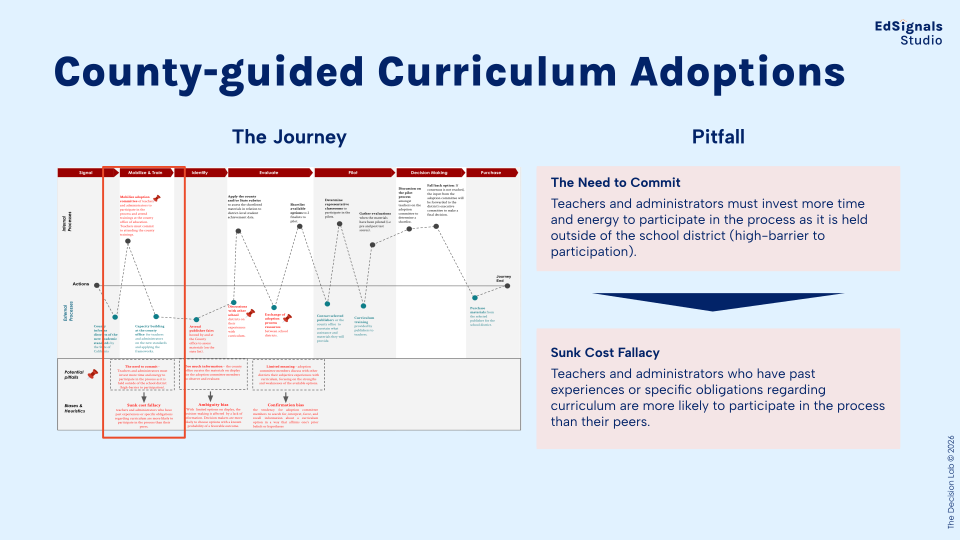
How can we encourage busy teachers to participate in early-stage development while minimizing biases that favor initial selections? One way to facilitate the process is to provide teachers with adoption rubric cheat sheets that make key curriculum evaluation information lightweight and accessible.3 This lowers the burden for teachers and allows them to participate in short windows between their other priorities. Similarly, objective checklists can help prevent teachers and administrators from sticking to early decisions and promote reliance on consistent evidence-use over mental shortcuts. In general, setting clear expectations at this stage about what teacher involvement will require (including communication methods, when their input will be solicited, how many teachers will be involved, and what the goals of their engagement are) is recommended.
The Studio also suggests using teacher role models at this stage. Role models—trusted and influential teachers who have navigated past adoptions—can encourage their peers to look at the bigger picture and connect their aspirations for instruction in the district with curriculum adoption.3 This simple form of social proof can encourage engagement from teachers who want to participate but just need a gentle nudge to turn those intentions into action.
Building Consensus Around Needs to Guide Materials Search
Managing competing stakeholder interests is another key challenge for districts.4 Administrators must balance state compliance concerns, teacher requests, community expectations, and the needs of subgroups such as multilingual learners, each with their own priorities. When these priorities conflict, district leaders struggle to establish a clear set of needs to guide material selection.
While consensus-building issues may be more obvious later in the curriculum adoption journey, this challenge is often rooted in early misalignments. In one recent survey, 49% of districts reported difficulties securing stakeholder buy-in during curriculum implementation, compared with only 13% that reported challenges determining district needs early in the process, and just 14% struggled with narrowing their curriculum options.5 This gap suggests that early decision-making might be driven by a false consensus effect or illusion of alignment, leading to challenges securing buy-in down the line. For example, smaller committees that make decisions with a limited understanding of stakeholders’ needs often face low enthusiasm from teachers after the decision is made, as well as inconsistent use of new materials in classrooms.5
Fortunately, there is a strong consensus among district leaders and educators on the importance of instructional materials and the features that define quality curricula.5 This reveals a solid foundation upon which districts can build consensus around curriculum needs. Leveraging this common ground, districts are well-positioned to bring stakeholders into deeper conversations about district needs, and this is where external support can be invaluable. Partnering with professional learning providers or capacity-building organizations can help districts engage diverse stakeholders, run facilitated processes to work through disagreements, create structured feedback opportunities, and introduce communication strategies to help stakeholders understand the rationale behind curriculum decisions.5
Navigating the Complex Regulatory Landscape
When it comes time to search for available materials and shortlist options for later evaluation, districts run into additional barriers. Navigating the regulatory landscape is notoriously complicated—districts rate “understanding and adhering to local, state, and federal regulations” as one of the most critical challenges.5 As policies trend toward a focus on high-quality instructional materials (HQIMs), it becomes increasingly difficult for districts to balance their own priorities while navigating regulatory changes. Districts are increasingly using state adoption lists to launch the materials search, but decision-makers often don’t know which requirements matter most or how to create criteria to narrow down their options.5
With state-structured adoptions, district administrators can feel rushed to make decisions quickly so they can adopt new materials shortly after state lists are released.3 Coupled with the complex regulatory environment, this time pressure can make districts vulnerable to cognitive shortcuts in the material selection process. For example, zero-risk bias—a preference for choices that eliminate perceived risk—can cause adoption committee members to favor safe and familiar options, such as previously-used vendors. In the face of these regulatory and time constraints, decision-makers might overvalue materials with established reputations of compliance while avoiding emerging options with no reviews. As a result, districts may inadvertently miss out on innovative, high-quality options.2
To help districts navigate complexity with greater confidence, partners in the ecosystem should focus on making regulatory information as clear and usable as possible. For example, organizations that specialize in curriculum quality can help districts interpret compliance requirements and translate them into evaluation criteria.5 Building internal expertise in this area is also valuable. When it comes to capacity-building, gamifying knowledge acquisition can help administrators better absorb and understand technical information about state standards.2 States can further support this process by creating clear guidance documents for districts, enabling more consistent decisions across the state.5
Addressing Information Overload During Early Materials Search
Even when districts understand the regulatory requirements they need to meet, they can still face difficulty sifting through the volume of information available during materials search. Curriculum adoption committees have to process information from state lists, peer recommendations, reviews, and inputs from publisher fairs, among other sources. This overwhelming collection of curriculum information is a common pain point for district leaders. Nearly one-third of surveyed district leaders report that collecting or interpreting data about their options is a key challenge.5
Information overload during the mobilize stage can make it difficult for adoption committees to form an accurate picture of their options or determine what’s best for their district. As a result, decision-makers often rely on fast, rule-of-thumb judgments. For example, the mental strain of processing so much information can lead to attentional bias, where decision-makers prioritize publishers or curriculum titles that are the most salient.3 Under significant time constraints, it’s easy to zero in on materials from large, recognizable publishers, while less visible—but potentially better-fitting—alternatives go overlooked.
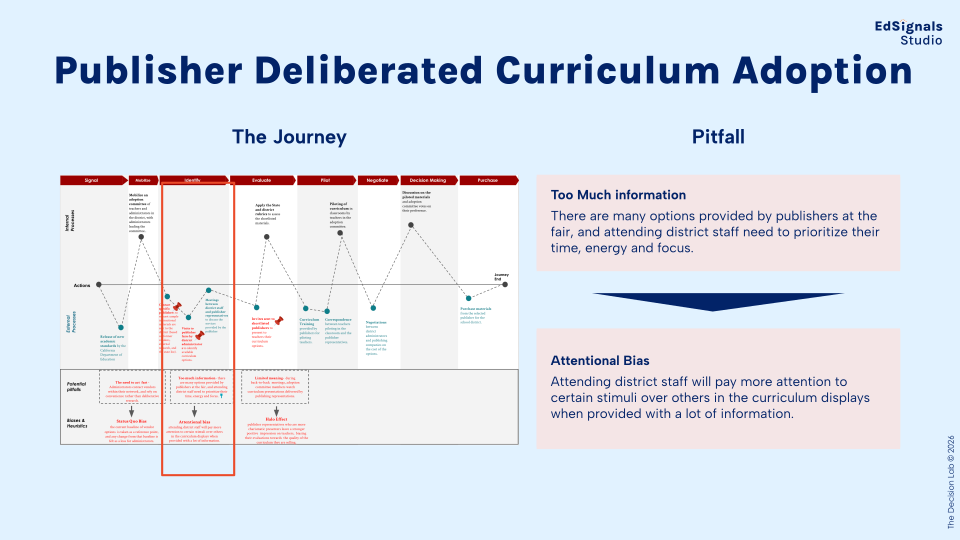
To help districts better narrow down their options, partners should focus on structuring the decision environment so that it’s easier to navigate. Toolkits like the Evidence Uptake Framework encourage instructional material reviewers and other curriculum partners to reduce noise by making information cognitively easy, physically convenient, and forwardly actionable.2 Similarly, organizing materials options with efficient choice architecture—for example, allowing online users to filter selections based on technical specifications or compatibility with existing infrastructure—can help reduce choice overload for time-constrained adoption committees. Traffic light indicators are another excellent way to reduce cognitive load by providing a quick visual overview of how various instructional materials perform against specific criteria; however, they should still be supplemented with more detailed information to support districts in determining their suitability for a specific context.
Offline, equipping evaluators with “red flag” cheat sheets can help them keep key criteria top of mind when assessing available options at publisher fairs. Overall, the goal is to support evidence-based decision-making instead of relying solely on surface-level characteristics as indicators of quality.
Setting the Stage for Successful Curriculum Adoption Decisions
The mobilize stage of the curriculum purchasing journey can alter the trajectory of the entire process, from evaluation to implementation. When districts effectively engage the voices of key stakeholders, align real district needs, navigate regulatory considerations, and cut through overwhelming curriculum information, they can lay the foundation for stronger decision-making in every stage that follows.
Districts have several behaviorally-informed strategies they can use to strengthen each element of the mobilization stage. These include engaging teachers with cheat sheets and role models, bringing in external support to facilitate consensus building, gamifying training to help administrators understand regulatory requirements, and providing decision-makers with efficient choice architecture to reduce cognitive overload. Together, these approaches can help districts address key challenges associated with this early stage of the purchasing journey and position themselves for long-term success.
Sources
- EdSignals Studio, Market Analysis: K-12 Teacher Prep Decision Maps, 2021
- EdSignals Studio, Smarter Demand: Dimensions of Quality in Purchasing Decisions, 2022
- EdSignals Studio, Market Analysis: K-12 Teacher Prep Decision Maps, 2020
- EdSignals Studio, Smart Demand: Integrating Buyer Insights into Signals for Solutions, 2024
- EdReports, The Decision Lab. (September 16, 2025). Beyond Selection: Rethinking How Districts Adopt Curriculum. https://www.edreports.org/resources/article/beyond-selection