Skip to main content
Choosing high-quality instructional materials plays a crucial role in improving student learning and closing achievement gaps; yet 70% of district leaders say the evidence needed to properly evaluate materials is difficult to find.1 This limited visibility creates significant barriers for districts during one of the most high-stakes stages in the purchasing process.
Evaluate is the phase of curriculum purchasing when districts assess the preliminary selection of materials and compare options against district expectations and needs. It involves first developing and applying evaluation criteria, then narrowing down curriculum options to a few top contenders. The evidence necessary for assessing materials is difficult to find, interpret, and apply, which means districts often struggle to effectively evaluate them. Without clear information, district leaders are sometimes constrained to decisions based on intuition or social cues rather than concrete evidence.
Based on these challenges, the EdSignals Studio has generated several strategies to directly address barriers associated with curriculum evaluation. These solutions include actionable resources to help third-party curriculum evaluators find and digest evidence more easily, as well as guidance to help districts apply evaluation criteria more consistently while reducing their reliance on familiar decision shortcuts. Together, these interventions can minimize the influence of structural and behavioral barriers during the evaluate stage, allowing districts to make decisions more deeply rooted in rigorous evidence.
Making Evidence Easier to Find and Access
Education professionals and curriculum purchasers worldwide are increasingly showing a preference for rigorous studies and more reliable evaluation methods; in one recent survey, 88% of educators agreed that this evidence is important when selecting curriculum materials.2 Nearly half rated efficacy or impact studies as the most credible forms of evidence, just ahead of case studies and reviews. While the majority of stakeholders want strong evidence of curriculum quality, getting this evidence in front of decision-makers remains a persistent challenge.
Finding and accessing evidence is often the most significant barrier facing district leaders during the material evaluation process. In a survey of 350 district leaders involved in selecting Curriculum-Aligned Professional Learning (CAPL) offerings, over two-thirds reported that their number one challenge with using evidence is actually finding it.1
Part of the issue is that the organizations producing evidence often operate outside the channels where district leaders naturally look for information. Many independent curriculum evaluators market themselves on social platforms like LinkedIn. However, district leaders are more likely to source information from familiar email communications, conferences, and government resources, leaving public evidence hubs overlooked and underutilized.1
Placing evidence in the buyer’s line of sight is crucial for increasing uptake, but gaining visibility on local and state agency platforms is not something third-party evaluators can achieve on their own. Centralizing evidence requires a coordinated, ecosystem-wide effort. Education agencies play a vital role in elevating credible evidence through the communication touchpoints buyers already use and trust. While external organizations can use tools like the Evidence Uptake Framework to make evidence easier to understand and act upon, they still require agency support to integrate that evidence into procurement portals, email newsletters, and adoption guides. This collaborative approach can help strengthen objectivity across the system by ensuring decision-makers at all levels rely on the same vetted, high-quality evidence.
Establishing Clear and Consistent Evaluation Criteria
Not only is evidence difficult to find, but it can also be challenging to interpret. Even when buyers can access evidence, many struggle with complex or ambiguous evaluation criteria that muddy the evaluation process.4 Districts face different rubrics, compliance requirements, and criteria from various sources, many of which can be contradictory. Unclear state standards—or a misalignment within districts on what criteria are most important—stand in the way of efforts to rigorously evaluate curriculum options.3
Because there is no universally standardized rubric or formalized process for evaluation, many districts create their own criteria.3 This isn’t unique to curriculum adoption; evidence from EdTech purchasing shows similar patterns, with only 33% to 41% of districts using pre-established evaluation criteria.5 While developing localized criteria ensures materials meet the unique needs of each district, many don’t have access to experts skilled in rubric design, which can lead to wide variation in how criteria are developed and applied.
Rather than replace locally developed criteria, agencies and third-party organizations can offer districts clear starting points for assessing the potential fit of a curriculum. For example, standardized evaluation “cheat sheets” can help districts identify high-quality instructional materials (HQIM) by summarizing state evaluation frameworks.4 At the same time, third-party evaluators can provide simple evaluation templates that districts can adapt and localize as needed, rather than creating their own criteria from scratch. Together, these supports can provide districts with a solid starting point for evaluating materials while empowering them to tailor the criteria to their individual needs.
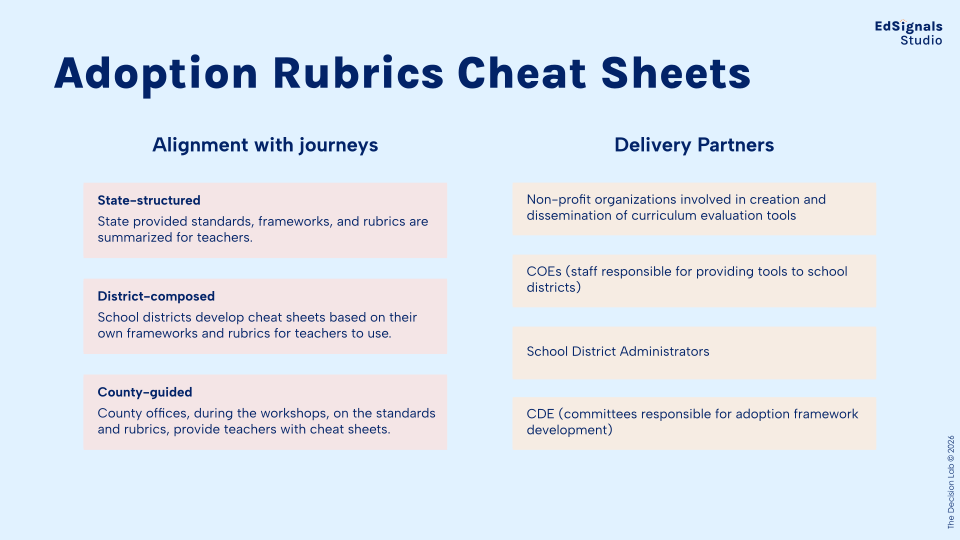
Training and capacity-building can further improve uptake of evidence-aligned evaluation criteria. Simply increasing training hours for administrators and teachers on standards, rubrics, and curriculum adoption frameworks can facilitate the organic sharing of information among adoption committees.4
Countering Cognitive Biases in Material Evaluation
District leaders often face severe time scarcity, especially amid limited budgets and reduced staffing. This creates a decision environment that favors easy-to-access information. As a result, evaluators tend to lean heavily on peers, anecdotes, and existing vendor relationships that reduce cognitive load, save time, and surface signals of safety and trust.
Surface-level indicators of curriculum quality, like the visual and graphic components, also play a significant role in shaping evaluation decisions.4 “Quality” signals even extend to the individuals presenting materials. Favorable impressions of a presenter can positively influence judgments about the material they’re presenting—this is a cognitive bias known as the halo effect.4 As a result, curricula can appear higher quality when presented by charismatic publisher representatives.

What’s more, decision-makers’ judgements can become anchored to their initial impressions of curriculum options, shaping how they perceive subsequent information. This can sway decisions in favor of materials that feel familiar or come with more salient indicators of quality, even if later evidence suggests other materials may better meet the district’s needs. Structured deliberation tools can help counter the pull of surface-level signals of quality. For example, blind materials evaluations—where the front covers and publisher names of materials are covered—can help committee members evaluate them more objectively.4
Another way to combat bias during material evaluation is to provide peer-validated evidence or use experts to help shortlist high-quality materials. Districts should also incorporate internal expertise, especially from teachers, who often report low levels of engagement in curriculum adoption.6 Encouraging teachers to weigh in ensures material evaluation aligns with classroom realities rather than relying solely on external perspectives or broader district-level goals. To translate teacher perspectives into rigorous insight, structured processes—such as protocols for gathering classroom insights and teacher representation on review communities—can redirect preferences for familiarity and trust toward stronger options than informal peer conversations.3
Advancing Evidence-Based Curriculum Evaluation
Ultimately, districts seek strong evidence when evaluating curriculum options, but face both structural and behavioral barriers when it comes to actually gathering and applying this evidence. Not only is evidence difficult to find, but its practical realization is shaped by inconsistent evaluation criteria and cognitive biases that influence both individual and group-level judgments.
Each of these barriers is an opportunity to implement practical interventions, such as centralized evidence platforms, standardized evaluation rubrics, objective evaluation practices, and structured group deliberation processes. Using tools and strategies like these is not just about increasing evaluation efficiency, but about moving toward evidence-based curriculum decisions that support better learning outcomes for students everywhere.
Sources
- EdSignals Studio, Cohort 1, 2025
- Oxford University Press. (2024). Buying Smart: Evidence-Driven Decisions in Education. https://oxfordimpact.oup.com/evidence-driven-decisions-in-education/
- Smarter Demand: Dimensions of Quality in Purchasing Decisions, 2022
- Market Analysis: K-12 Teacher Prep Decision Maps, 2020
- Smarter Demand: Dimensions of Quality in Purchasing Decisions, 2022
- EdReports, The Decision Lab. (September 16, 2025). Beyond Selection: Rethinking How Districts Adopt Curriculum. https://www.edreports.org/resources/article/beyond-selection